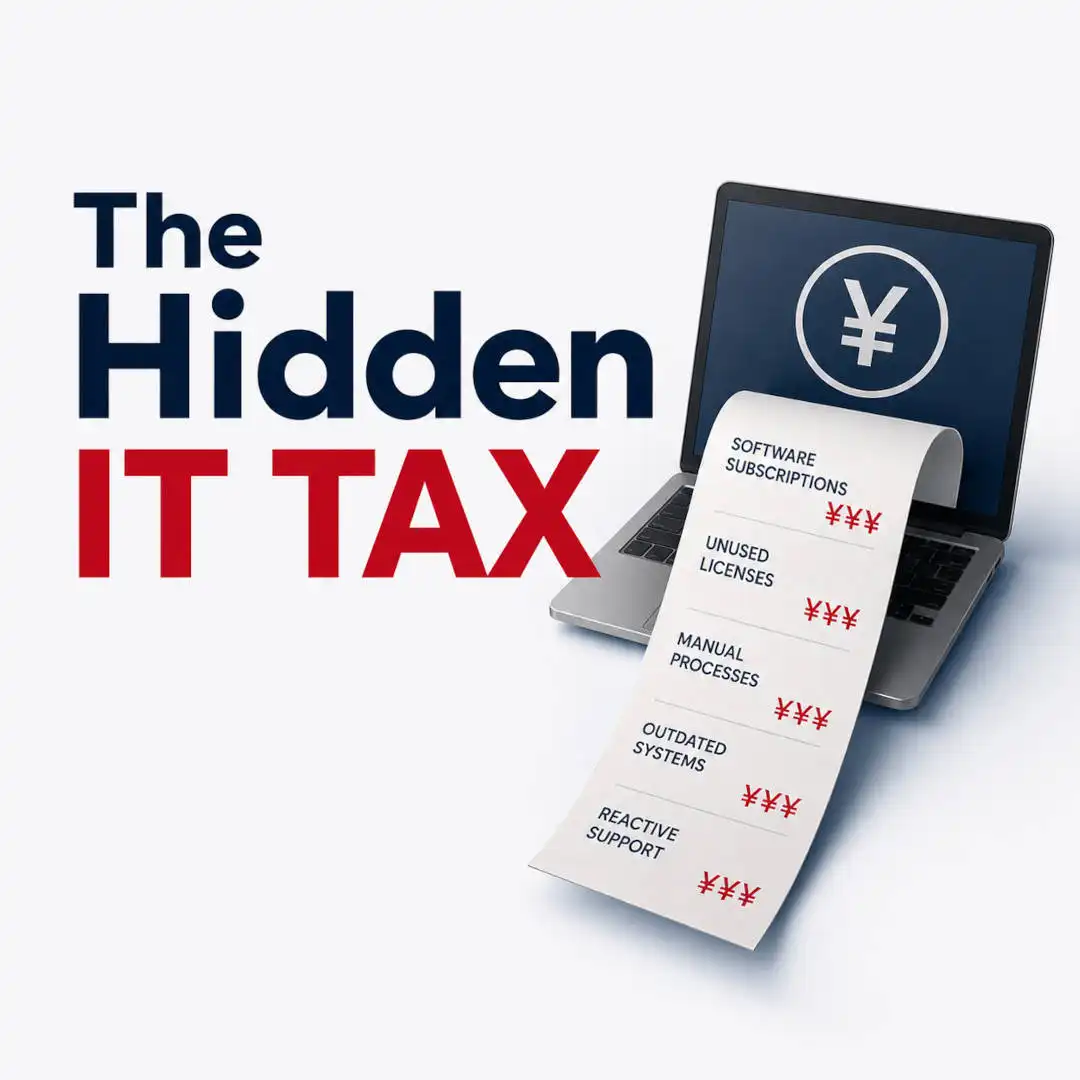
The Hidden IT Tax: 5 Ways Small Businesses in Japan Overpay Without Knowing It

If you run a small or growing business in Gunma, Saitama, or anywhere in Japan, you probably think you'd notice if your IT spending got out of control. A big invoice would land on your desk, and you'd deal with it.
That's not usually how it happens.
In most small businesses, IT overspending doesn't arrive as one alarming bill. It arrives as five quiet decisions, made for good reasons at the time, that slowly compound into what is call the Hidden IT Tax, money leaving your business every month with no line item that says "waste."
Here are the five most common ways it happens, and what to do about each one.
1. Unauthorized software risk (a.k.a. "shadow IT")
Picture this: your accounting team needs to share a file quickly, so someone signs up for a free cloud storage account. Your sales team wants a better way to track leads, so they start using a spreadsheet tool nobody in IT approved. None of this feels like a decision, it feels like getting work done.
But every one of these unapproved tools is a small, invisible liability. Your company data is now sitting in a service nobody vetted, with a login nobody manages, on a subscription that renews automatically whether anyone uses it or not.
This isn't a niche problem. Industry surveys consistently put unsanctioned software and AI tool use among employees as high as 80%, and IBM's 2025 Cost of a Data Breach report found that breaches involving unsanctioned "shadow AI" tools cost organizations roughly $670,000 more on average than breaches that didn't. Most of that exposure has nothing to do with bad intentions, it's what happens when official tools don't match how people actually need to work.
What this costs you: unmanaged data risk, compliance exposure, and increasingly direct financial risk if a breach happens through a tool your IT policy never approved.
What actually fixes it: not a ban (bans just push the behavior further underground), but a genuine audit of what your team is really using, followed by either sanctioning the right tools properly or replacing them with something that fits the workflow and is under your control.
2. Subscription and license waste
Software subscriptions are easy to start and easy to forget. A tool gets bought for a project that ends. An employee who used a paid seat leaves the company, but the seat stays active. A team upgrades to a higher tier "just in case" and never uses the extra features.
Individually, each of these looks trivial. At scale, it isn't. Industry analysts including Gartner and Zylo consistently find that somewhere between a quarter and a third - some studies put it well above that - of enterprise SaaS spend goes toward licenses that are unused, underused, or simply duplicated across teams.
Small businesses aren't protected from this by their size. If anything, they're more exposed, because there's rarely a dedicated person whose job is to track every renewal.
What this costs you: a slow, compounding drain that never shows up as a single "mistake", just a software budget that keeps climbing while nobody can say exactly why.
What actually fixes it: a periodic license audit, who has access to what, who's actually using it, and what could be consolidated, downgraded, or canceled without anyone noticing the difference.
3. Vendor lock-in disguised as advice
This is the one most consultants won't tell you about, because it's often coming from the consultant.
A lot of "IT consulting" in the small business world is really a certification with a sales pitch attached. A consultant certified in one company's ecosystem has every incentive, training investment, partner incentives, familiarity, to recommend that company's products, whether or not they're actually the best fit for your business at its current stage.
That's not necessarily dishonest. It's structural. Someone whose expertise and income are tied to one vendor will, consciously or not, see that vendor's solution as the answer to most problems.
The cost of this is not always obvious upfront. It shows up later, as licensing costs that scale awkwardly with your growth, as tools that lock your data into a proprietary format, or as a roadmap that quietly narrows to "whatever this vendor sells next," instead of what your business actually needs.
What this costs you: decisions optimized for a vendor relationship instead of your bottom line, often for years before anyone notices.
What actually fixes it: advice from someone with no product to sell, someone whose recommendation is the same whether it points toward a proprietary platform, an open-source alternative, or something in between.
4. Legacy technical debt
Every business accumulates some technical debt: systems, processes, and workarounds that were reasonable choices once and have quietly become a drag on productivity. What's easy to miss is how much this actually costs.
At a national level, Japan's own "2025 Digital Cliff" discussions, the term METI has used to describe the risk posed by aging core IT systems across the economy, point to outdated infrastructure costing the broader Japanese economy an estimated ¥12 trillion a year in lost productivity. That figure is about large legacy systems at scale, but the underlying pattern is identical at the small business level: manual double-entry between systems that don't talk to each other, workarounds nobody remembers the reason for, and software nobody wants to touch because nobody fully understands it anymore.
What this costs you: hours of staff time every week that never gets counted as an IT cost, because it looks like "just how we do things."
What actually fixes it: an outside look at your actual workflows, not just your software licenses, to find out where time is quietly leaking, and a realistic, staged plan to modernize the parts that are actually costing you.
5. Missed subsidies
This is the one small business owners are most surprised by.
Japan runs a national subsidy program to support small and medium businesses adopting digital tools, historically known as IT導入補助金, renamed for the 2026 fiscal year to デジタル化・AI導入補助金 (the "Digitalization/AI Adoption Subsidy"). Depending on the specific application frame and your business's size and wage profile, the program can cover roughly half of qualifying software costs, and in some cases up to 80% for smaller businesses meeting certain conditions.
Many small businesses never apply, not because they don't qualify, but because nobody walked them through what actually qualifies, and applications have to go through a government-registered support provider, not just any vendor or consultant.
What this costs you: money you were entitled to and simply never claimed, on tools you were likely going to buy anyway.
What actually fixes it: working with someone who understands both your technology roadmap and the current subsidy landscape, so the two conversations happen together instead of separately (or not at all).
The pattern behind all five
Look closely at these five leaks and you'll notice something: none of them are the result of one bad decision. They're the accumulated result of small, individually reasonable choices, made without a full, unbiased picture of the alternatives.
That's the core problem with certified, single-vendor IT advice: it can only ever recommend what it's certified in. It's not built to tell you when the right answer is "you don't need to buy anything," or "the open-source option will save you five years of licensing costs," or "this subsidy already covers most of what you were about to pay for."
What a vendor-neutral audit actually looks like
I work as an independent, certification-free IT consultant for exactly this reason. Not being tied to any single vendor means I have no product to steer you toward, only your actual situation, your stage of growth, and an honest comparison of every option that could fit it, proprietary or open-source.
For businesses in Gunma, Saitama, and remotely across Japan, that usually starts with a simple conversation: what are you currently paying for, what's it actually doing for you, and where is the gap between the two?
If you suspect your business might be paying a version of this Hidden IT Tax, and most businesses are, whether they've noticed it or not, I'd be glad to take a look with you.
Get in touch for a free initial consultation.
Feel free to reach out Contact Form
or