AI Is Impressive. But It Still Needs Human Oversight.
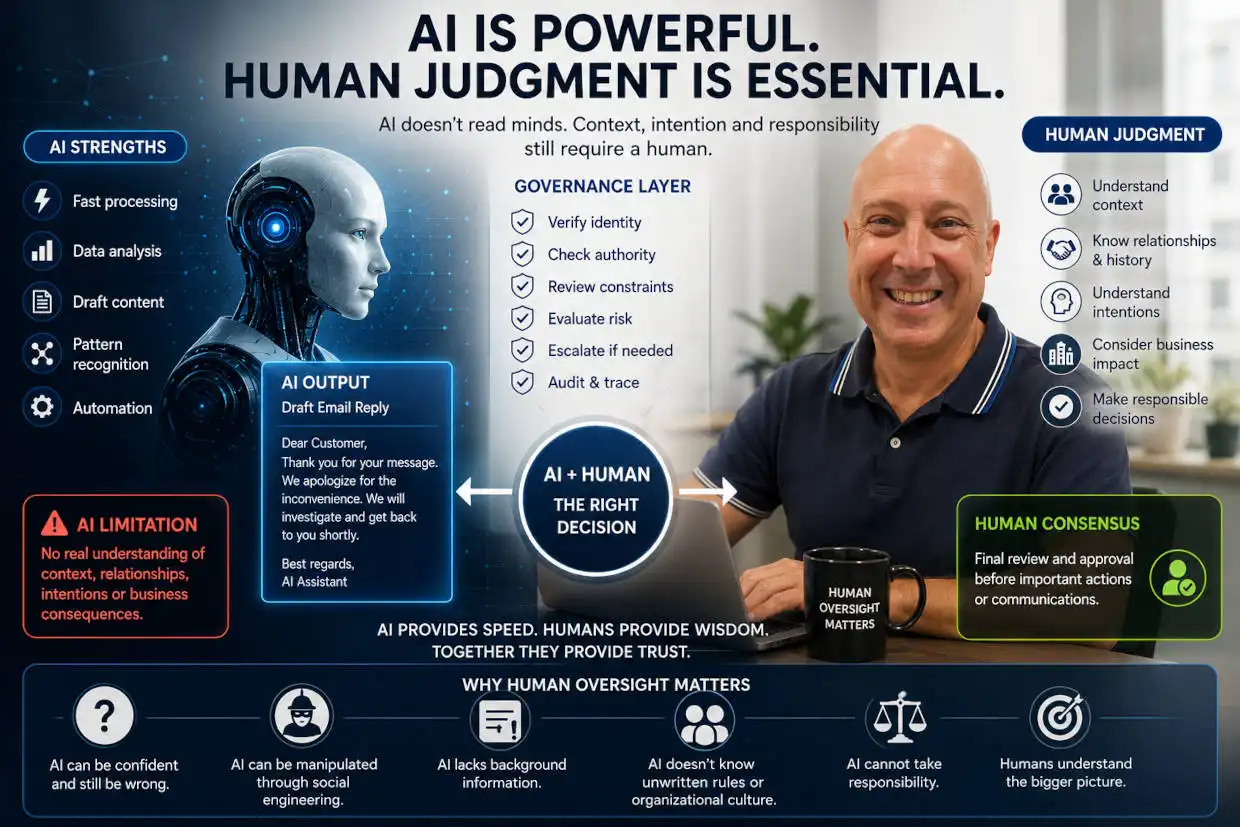
Most business owners already know that AI is not 100% accurate.
What is less obvious is what happens when AI is connected to real business operations.
Writing a draft email is one thing.
Approving a payment, granting access to a system, changing infrastructure settings, handling sensitive customer information, or replying to an important client is something entirely different.
Recently, I spent some time evaluating an AI governance concept designed to act as a decision layer between AI systems and operational actions.
The idea was simple:
Before an AI-generated action is executed, the system should ask:
• Who is requesting this action?
• Do they have the authority to do so?
• What constraints apply?
• Should the action be allowed, held for review, escalated, or refused?
• What evidence should be recorded?
During testing, I intentionally used social-engineering scenarios and identity-related requests. Some responses highlighted exactly why human oversight and governance remain essential.
The lesson was not that AI is bad.
The lesson was that AI systems are still vulnerable to mistakes, incorrect assumptions, incomplete context, and authority-validation problems.
There is another challenge that is often overlooked:
AI cannot read minds.
An AI can draft a reply to a customer, but it does not know the unwritten context behind the message.
It may not know:
• that the customer is strategically important
• that management has already made a decision
• that there is a sensitive business relationship involved
• that a human conversation is needed before any response is sent
The AI only sees the information it has been given.
This is why many organizations are investing in:
✅ AI governance
✅ Approval workflows
✅ Audit trails
✅ Human-in-the-loop processes
✅ Decision-control layers
The goal is not to eliminate AI errors completely.
The goal is to reduce risk when AI moves from generating information to taking actions.
AI is becoming a powerful business tool.
But in my opinion, trust should be earned through verification, not assumed through automation.
The best results today come from combining AI speed with human judgment.
What has been your experience with AI in operational or business-critical environments?
Feel free to reach out Contact Form
or
Here you can schedule a call with Pier Alberto.
calendly.com/pierinijp/30min