Web Design and Development: Why the Last Step Only Works When Every Step Before It Has Been Done Right
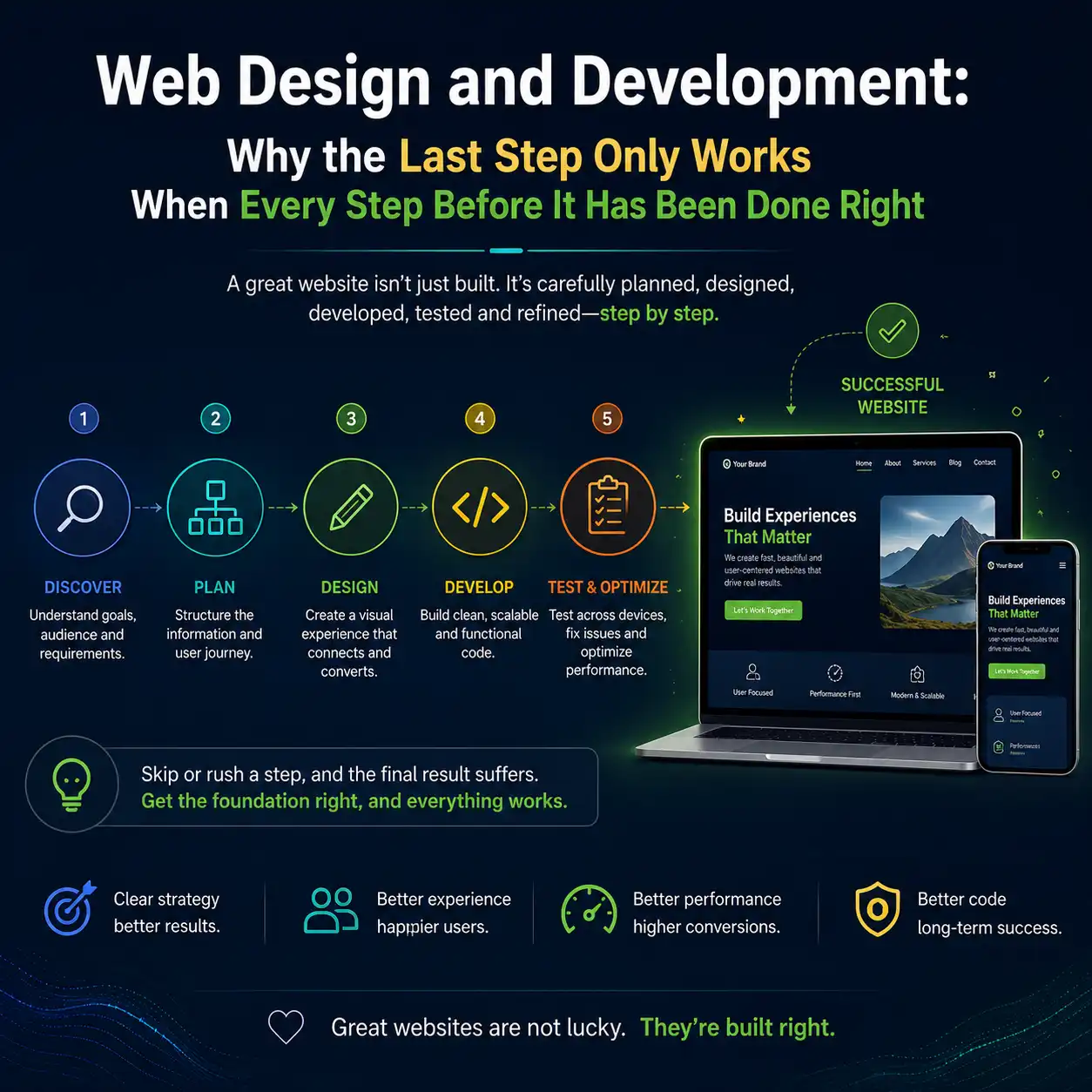
Step 5: Design & Development: Where Everything Either Comes Together or Falls Apart
This is the step everyone starts with. It is also the step that only works when everything before it has been done correctly. After six weeks, we have arrived at the moment most people think of as "building the website." But by now, you understand why it is actually the last step, not the first.
Welcome to the final article in this series. Over the past five weeks we have worked through Analysis, Site Map, Customer Journey, and Wireframe, four steps that are invisible to the visitor but entirely responsible for whether the website performs. Now we arrive at the step that is most visible, most exciting, and when it is grounded in all the work that preceded it the most powerful.
Design and Development done correctly is not an act of creativity in a vacuum. It is the translation of a deeply researched, carefully mapped, structurally validated strategy into a visual and functional experience. The design expresses what the analysis understood. The development builds what the wireframe planned. The result is not just a website that looks good. It is a website that works.
When this step is done without the foundation which is how most websites are built, the result looks professional and performs poorly. The gap between appearance and function is the gap between assumption and understanding. And it costs businesses real clients, real revenue, and real time every single day.
Why Design Is Not What Most People Think It Is
94% of first impressions are based on web design, and users form an opinion about a site in just 50 milliseconds. This statistic is cited constantly in the web design industry usually as an argument for investing in beautiful visuals. But it carries a more important implication than most people draw from it.
That first impression is not formed by color alone. It is formed by the totality of what the visitor encounters in the first fraction of a second: the visual hierarchy, the clarity of the message, the sense that this website knows exactly who is visiting and what they need. A beautiful page with confusing structure creates a negative first impression just as efficiently as an ugly one. The 50-millisecond window does not reward aesthetics. It rewards clarity.
Poor design and content drive 38% of web visitors away. Note that this figure includes content, not just visual design. The design phase is not only about how the website looks. It is about how it communicates. Every visual decision: typography, color, spacing, imagery, the weight and placement of a button, carries a communicative intention. And that intention must be aligned with what the visitor needs to feel at each specific moment in their journey.
This is the intersection of aesthetics and psychology. A designer who understands only aesthetics produces a website that looks impressive in a portfolio. A designer who understands both produces a website that brings clients.
The Psychology of Visual Design
I can tell you that the design decisions that matter most are almost never the ones that generate the most discussion.
Nobody argues about the placement of the contact button in a wireframe review. Everyone argues about the shade of blue. And yet the placement of the contact button has a direct, measurable impact on conversion rates, while the shade of blue, within a reasonable range, has almost none.
Center-aligned CTAs receive 682% more clicks compared to left-aligned ones. CTAs placed above the fold are 73% more visible, whereas visibility drops to 44% when placed below the fold. These are not design opinions. They are behavioral facts. The design phase must be informed by them.
Fitting colors rank second among visual elements by influencing 39% of users, followed closely by typography, infographics, videos, and animations. 40% of visitors value images as an essential element on company websites. Each of these elements carries psychological weight and each must be chosen in deliberate service of the visitor's experience, not the designer's preference or the business owner's personal taste.
Typography communicates tone before a single word is read. Spacing signals professionalism or its absence. Imagery either reinforces the message or distracts from it. Color establishes emotional context. None of these decisions should be made arbitrarily, and none should be made before the strategic foundation is in place.
Visual hierarchy optimization improves content consumption speed by 27%. That figure translates directly into conversion: a visitor who consumes content efficiently moves through the journey more quickly, encounters fewer points of friction, and arrives at the conversion moment with more motivation and less doubt.
What Design Must Deliver: Page by Page
The design phase does not treat the website as a single visual object. It treats each page as a distinct communication challenge with its own emotional requirements, informed by everything the Customer Journey revealed about what the visitor is feeling at that specific moment.
The homepage design must achieve orientation and relevance within three seconds. The headline must speak directly to the visitor's problem, not to the business's identity. The visual hierarchy must guide the eye naturally from awareness to interest to the first call to action. Neuroscience research confirms that high-quality visuals are encoded in the human brain 74% faster than text which means imagery on the homepage is not decoration. It is communication that arrives before the words do.
The services page design must build desire and credibility simultaneously. Features must be translated into outcomes. Evidence, case studies, testimonials, specific results, must appear at the exact moments where doubt is most likely to arise. The visual design must signal expertise without creating distance.
The about page design must build the human connection that converts a cautious visitor into a trusting one. 78% of customers explicitly state they want consistent brand experiences across all channels. The About page is where brand consistency is most tested and where it pays the highest dividends in trust.
The contact page design must reduce friction to the absolute minimum at the moment of maximum hesitation. A form with too many fields, a page with no warmth, a layout that feels bureaucratic rather than welcoming any of these can lose a visitor who has traveled the entire journey and arrived ready to act. 70% of small business websites fail to include an effective CTA, potentially losing valuable leads and sales. The contact page is where that failure is most costly.
The Development Phase: Where Design Becomes Reality
Development is the process of turning the approved design into a functioning website and it is where a second, less visible set of decisions determines whether the website performs in the real world.
Performance is the first imperative. Websites that take over two seconds to load potentially lose 60% of their visitors. Even just a one-second delay can lead to 7% fewer conversions. Speed is not a technical nicety. It is a conversion factor. A beautifully designed website that loads slowly loses more than half its visitors before they see a single page. Development must prioritize performance as a first-order concern, not an afterthought.
Mobile optimization is the second imperative. Mobile-optimized websites see 40% higher conversion rates. If a website is not optimized for mobile, users are five times more likely to abandon their tasks. A website that has not been developed with mobile as a primary consideration is not a professional website in 2026. It is an incomplete one.
Accessibility is the third imperative and the one most consistently ignored. Beyond the legal risk, the business case is clear: 1.3 billion people live with a disability globally, representing an enormous and consistently underserved audience. A website that is not accessible is a website that is actively turning away clients.
SEO structure is the fourth imperative. Development must build the technical foundations that allow the website to be found, clean code, semantic HTML, fast load times, correct heading hierarchy, proper metadata, and a structure that makes Google's job as easy as possible. A website that cannot be found is a website that cannot convert, regardless of how well it has been designed.
The Relationship Between Design and Development: Where Most Projects Break Down
In a well-run process, design and development are in constant conversation. The developer understands the strategic intent behind each design decision. The designer understands the technical constraints that shape what is possible. The result is a website where the vision and the execution are aligned.
In a poorly run process which is far more common, design and development are sequential and isolated. The designer produces a beautiful set of files. The developer builds something that approximates it, making hundreds of small compromises along the way. Those compromises, individually minor, collectively undermine the precision of the original intent.
Design systems and reusable components reduce development time by 35% on average. A design system, a consistent set of visual and functional standards that govern every element of the website, ensures that the gap between design and development stays closed throughout the build. It is one of the most practical investments a web project can make, and one of the most frequently skipped.
Companies using analytics and UX research to inform design decisions achieve two to three times higher conversion rates than those relying on intuition alone. The design and development phase is where that research is finally expressed and where the discipline to honor it, rather than override it with personal preference, determines the outcome.
Why the Process Matters More Than Any Single Step
We have now completed all five steps. And I want to close this series by returning to the observation with which it began.
Most websites fail not because they are badly designed. Most fail because they were built out of sequence, starting with what is visible before understanding what is invisible. Starting with color before understanding the customer. Starting with development before mapping the journey. Starting with the exciting part before doing the essential work.
61.5% of website redesign projects are undertaken to fix user experience issues. Redesigns are expensive, disruptive, and demoralizing. The vast majority of them are avoidable with a process that asks the right questions before a single design decision is made.
Allocating just 10% of a development budget to UX can result in an 83% increase in conversions.
A website built on this foundation does not just look professional. It communicates with precision. It guides with intelligence. It converts with consistency. And it does all of this because it was designed around the visitor not around the assumptions of the people who built it.
Feel free to reach out Contact Form
or
Here you can schedule a call with Pier Alberto.
calendly.com/pierinijp/30min