Website Wireframing: The Step That Separates Websites That Convert From Websites That Just Look Good
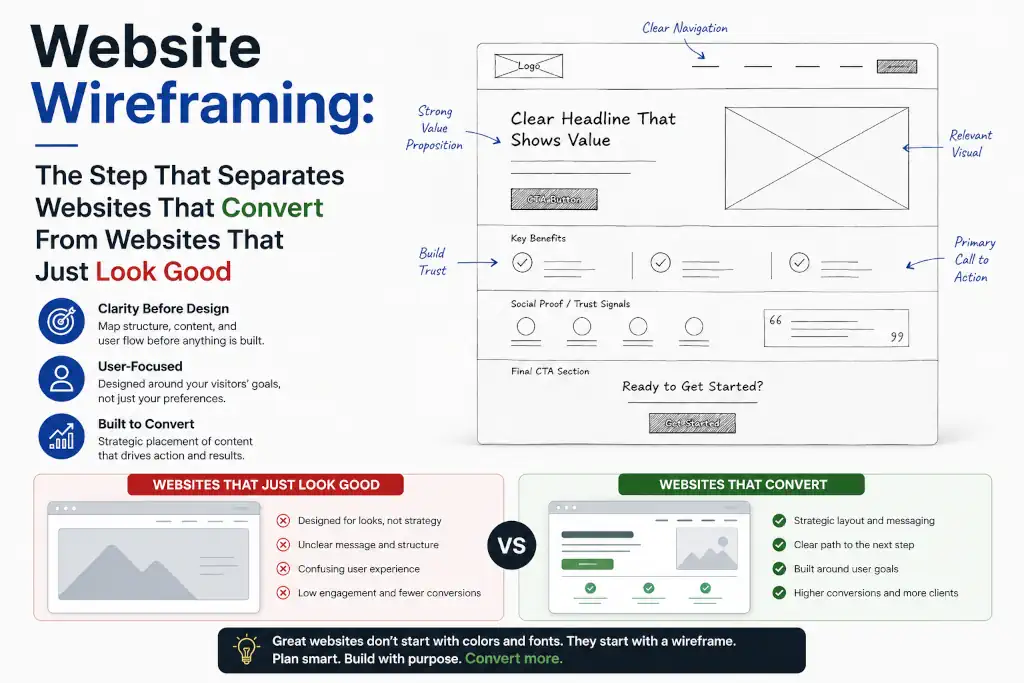
Step 4: The Wireframe: Where Strategy Finally Takes Shape
This is the moment where everything you have learned about your visitor, your structure, and your customer journey stops being invisible and becomes something you can see, test, and argue about before a single line of code is written or a single color is chosen.
Welcome to Week 5. We have now covered Analysis, Site Map, and Customer Journey, three steps that are entirely strategic, entirely invisible to the visitor, and entirely foundational to whether the website will work. Now we arrive at the Wireframe: the step that bridges all of that thinking with the physical reality of the website itself.
The Wireframe is, in my experience, the most satisfying step in the entire process and the most frequently skipped or rushed by people who do not understand what it is actually for. When it is done well, with all the previous steps informing it, the Wireframe is not just a sketch. It is the culmination of everything the process has built. It is strategy made visible.
When it is skipped or done quickly as a formality it is one of the most expensive mistakes a web project can make.
What a Wireframe Is and What It Is Not
A wireframe is the skeletal layout of a website or app that defines its structure, navigation, and content hierarchy. It acts as a visual blueprint showing how users interact with key elements before design or development begins.
This definition contains a word that is worth emphasizing: skeletal. A wireframe has no color. No typography choices. No photography. No branding. It is deliberately stripped of everything visual so that the only conversation possible is a structural and strategic one.
In a wireframe critique, nobody says "I don't like the yellow." Everyone talks about priorities, flows, and clarity.
This is precisely the point. Color triggers emotional and aesthetic reactions. Typography sparks personal preference debates. Photography opens discussions about style and brand. All of those conversations are legitimate but they belong in the design phase, not here. The Wireframe exists to answer one question and one question only: Does this structure serve the visitor's needs and guide them toward the action we want them to take?
Wireframes clarify structure early, helping teams avoid costly revisions, misalignment, and unclear expectations. They surface gaps in logic, reveal layout issues early, and make it possible to gather feedback while changes are still quick and inexpensive to implement.
Skipping this crucial phase can increase development costs by up to 50% due to late-stage changes. A business owner falls in love with a visual design, approves it, development begins and then, weeks into the build, fundamental structural problems emerge that require dismantling significant portions of the work. Problems that would have taken an hour to fix at the wireframe stage cost days or weeks to fix in development.
The Three Levels of Wireframe Fidelity
Not all wireframes are the same. There are three main types of wireframes every designer should know: low-fidelity, mid-fidelity, and high-fidelity. Each serves a unique purpose in shaping a user-friendly, high-performing website or app.
Low-fidelity wireframes are the starting point rough, fast, and intentionally simple. They use basic shapes, placeholder text, and minimal detail to establish the overall layout and flow of a page. Their value lies precisely in their roughness: because they are obviously unfinished, they invite honest feedback. Nobody defends a sketch the way they defend a polished design. Use low-fidelity wireframes for early exploration, to generate ideas, and to compare different layout options before anything is locked in.
In my own process, I almost always begin with paper. A pencil and a blank page. The constraint forces fast, decisive thinking about what goes at the top, what sits below it, and where the conversion point lives. It is the most analog step in an otherwise digital process and one of the most valuable.
Mid-fidelity wireframes add definition. They show spacing, hierarchy, navigation structure, and content placement with clearer intent. They are close enough to the final structure to enable meaningful discussion, but still free of visual distraction. This is where most of the serious structural decisions are made and refined. Mid-fidelity wireframes are best for usability discussions and mid-stage reviews, to ensure design consistency, refine navigation, and align everyone on functionality and content placement.
High-fidelity wireframes are detailed, near-final representations. They include real content, accurate spacing, interactive elements, and sometimes even placeholder imagery. They are used to validate the structure before design begins and to provide developers with a clear, unambiguous blueprint for the build ahead.
A common mistake is starting directly from high-fidelity because "it's faster." It looks faster but stretches the process by 30–50% because every structural change forces you to redo the visuals too.
What the Wireframe Must Answer: Page by Page
The Wireframe does not treat the website as a single object. It treats each page as an individual challenge with its own specific goal and it builds the structure of each page around that goal.
The Homepage wireframe must answer: What does a first-time visitor see within three seconds? Does it establish relevance immediately? Is there a clear primary call to action above the fold? Does the hierarchy guide the eye naturally downward toward the next step? Neuroscience research confirms that high-quality visuals are encoded in the human brain 74% faster than text which means the spatial arrangement of elements on the homepage is not a design preference but a psychological decision about what the visitor perceives, and in what order.
The Services page wireframe must answer: Does each service have enough context for a visitor who knows nothing about the business? Are outcomes communicated not just features? Is there a conversion prompt at the point of maximum interest, not just at the bottom of the page?
The About page wireframe must answer: Does this page build trust in the way a skeptical visitor actually needs trust to be built through credibility, human connection, and demonstrated understanding or does it simply recount the company's history in a way that serves the ego rather than the visitor?
The Contact page wireframe must answer: Does this page reduce friction at the most critical moment of the entire journey? Is the form short enough to be approachable? Is there clarity about what happens after submission? Is there any reassurance a testimonial, a response time commitment, a human face to bridge the final gap of doubt?
Each of these questions is answered at the Wireframe stage. Each is far more difficult and expensive to answer at the development stage.
The Consumer Psychology Behind Wireframe Decisions
Every structural decision in a wireframe has a psychological consequence. Where the eye is drawn first. What information feels primary and what feels secondary. Where doubt arises and whether it is addressed before it causes the visitor to leave. How much cognitive effort is required to understand what the page is offering and what the visitor is supposed to do next.
By removing aesthetic considerations, wireframing forces a focus on usability, ease of navigation, and the efficiency of the user journey the true keys to user retention and conversion.
Three principles from behavioral psychology guide every wireframe:
Visual hierarchy: The human eye does not read a webpage the way it reads a book. Research consistently shows that visitors scan in patterns typically F-shaped or Z-shaped depending on the content density and that only a fraction of the page receives genuine attention. A wireframe built without understanding this produces pages where the most important content is positioned exactly where the visitor is least likely to look.
Cognitive load reduction: Every element on a page that does not serve a clear purpose adds to the mental effort required to process the page. That effort, accumulated across multiple elements, creates fatigue and friction. A wireframe built around the principle of cognitive load reduction removes everything unnecessary and ensures that every remaining element earns its place.
Conversion proximity: The call to action, the button, the form, the phone number, must be positioned at the moment of maximum motivation, not at an arbitrary point determined by design convention. A well-designed website can increase qualified lead volume by 200-300% without additional traffic, the secret lies in reducing friction at every micro-decision point throughout the user journey. The Wireframe is where those micro-decision points are identified and addressed before they become embedded in code.
Why DIY Builders and Many Designers Skip This Step and What It Costs
The most common reason given for skipping the Wireframe is impatience. Business owners want to see the website. Designers want to do the work they enjoy. The Wireframe feels like a delay a grey, boring intermediate stage between the exciting idea and the exciting visual.
At first glance, wireframing seems simple. And herein lies the major problem: we tend not to pay enough attention to simple things.
The second reason it is skipped is overconfidence. A designer who has built many websites trusts their instincts about structure. A business owner who knows their industry trusts their instincts about what visitors need. Both forms of confidence are understandable. Both, in the absence of a wireframe, produce websites that reflect the assumptions of the builder rather than the needs of the visitor.
88% of online consumers are less likely to return to a site after a bad experience. That bad experience almost always originates in a structural decision that was never questioned because there was no wireframe stage at which to question it.
The Wireframe is, in essence, the last point in the process where change is cheap. After this, every structural adjustment costs time, money, and often the goodwill of everyone involved in the project. It is not a formality. It is an insurance policy against every assumption that has not yet been tested.
What Comes Next
With the Wireframe complete, the website has a tested, validated structure. Every page knows its purpose. Every element knows its role. Every conversion point has been deliberately placed. The strategic work is done.
Now and only now does the real visual and technical work begin. Design and Development: the final step, where the skeleton receives its skin, its voice, its color, and its code. That is the focus of next week's final article in the series.
It is also, as I will explain, the step that is easiest to get right when everything before it has been done correctly and the step most likely to go wrong when it has not.
Feel free to reach out Contact Form
or
Here you can schedule a call with Pier Alberto.
calendly.com/pierinijp/30min