Customer Journey Mapping for Websites: Why Your Visitors Leave Without Converting (And How to Fix It)
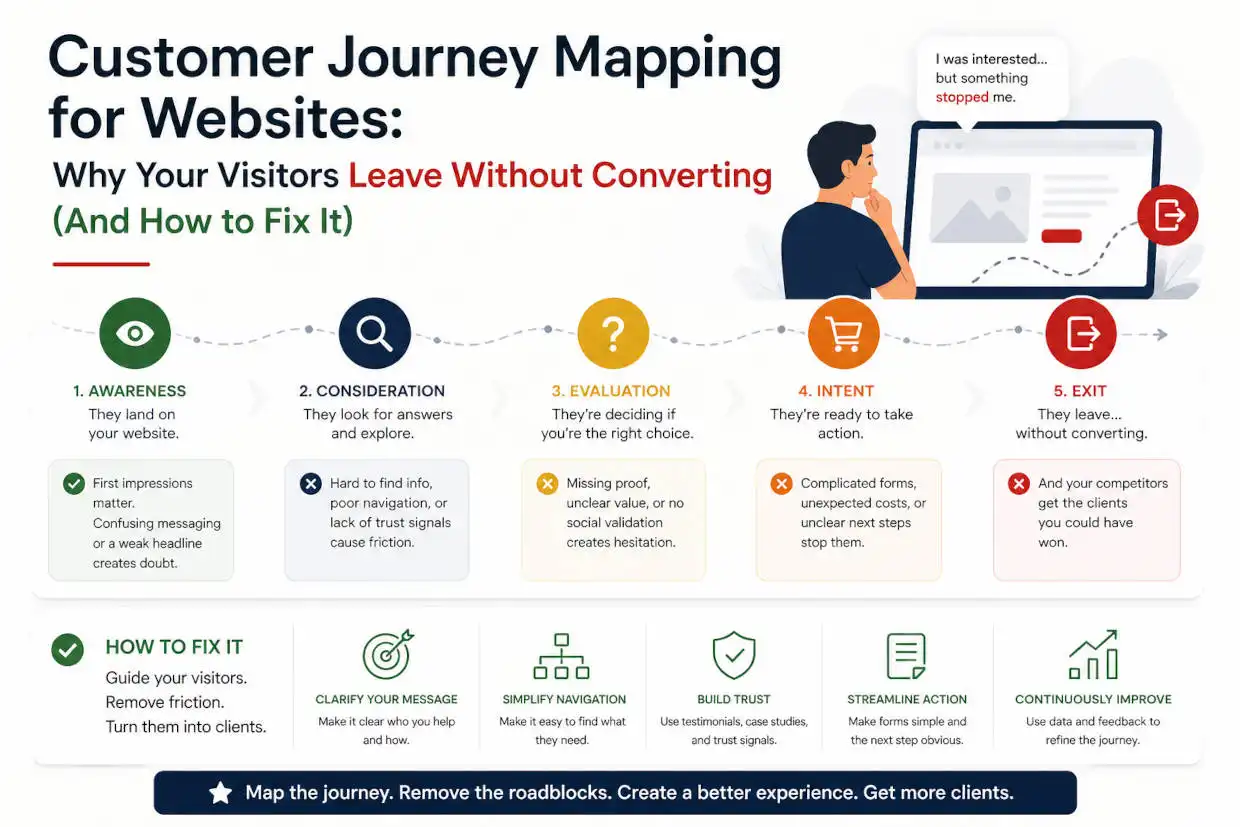
Step 3: The Customer Journey - The Map That Turns Visitors Into Clients
Your website doesn't have a traffic problem. It has a journey problem. And the difference between a website that converts and one that doesn't is almost always found somewhere along the path a visitor takes in the moments nobody designed deliberately.
Welcome to Week 4 of the series. So far we have covered Analysis, understanding who your visitor is before you build anything and the Site Map, the architecture that gives your website a logical, visitor-centered structure. Now we go deeper into the single most revealing step in the entire process: the Customer Journey.
This is the step where I have seen the most dramatic gap between what business owners believe their website does and what it actually does. Most believe their website guides visitors clearly toward a decision. The data, and the behavioral evidence, almost always tells a different story.
What the Customer Journey Actually Is
The Customer Journey is not a marketing funnel. It is not a list of pages. It is not a technical diagram.
A customer journey map is a visual representation of every experience a customer has with a brand, capturing the customer experience from the consumer perspective, visualizing the touchpoints, emotions and potential pain points they encounter throughout their relationship with a brand.
The key word in that definition is emotions. Most web designers think about pages and clicks. Consumer behavior tells us we need to think about feelings because feelings drive decisions far more reliably than logic does.
A Salesforce report found that 80% of customers value their experience with a company just as much as the product itself, the how is just as important as the what.
This means that the path a visitor takes through your website, the sequence of impressions, the moments of doubt, the points of reassurance, the instant they decide to act or to leave is not just a technical matter. It is a psychological one. And it needs to be designed with that psychology in mind.
The Five Stages Every Visitor Moves Through
Whether you are selling a product, a service, or an idea, every visitor to your website moves through a version of the same five stages. Most websites only design for one or two of them and wonder why the others do not convert.
Awareness: The visitor arrives. They may come from a Google search, a social media post, a referral, or an advertisement. At this moment, they know almost nothing about you. Their primary need is orientation: "Am I in the right place?" "Does this look like it can solve my problem?" You have approximately 50 milliseconds to create a positive first impression, 94% of users judge a website based on design and form an opinion in just 0.05 seconds. If that first impression fails visually, tonally, or structurally the journey ends here.
Consideration: The visitor begins to explore. They read, compare, scroll, and assess. They are asking: "Is this business credible?" "Do they understand my situation?" "Can I trust them?" This is the stage where most websites lose people silently, not through a dramatic failure, but through a slow accumulation of unanswered questions, unclear messaging, and missing proof. By visualizing the entire journey, you can spot roadblocks, bottlenecks, and areas where customers drop off. Addressing these friction points directly leads to a smoother, more intuitive experience, reducing churn and improving customer satisfaction.
Decision: The visitor reaches the point of action. They are close to converting but this is also where doubt peaks. They need reassurance: testimonials, case studies, clear pricing, a low-friction contact method, and a compelling reason to act now rather than later. Most websites either rush this stage assuming the visitor is ready before they are or they bury the conversion point so deeply that the motivated visitor cannot find it.
Action: The visitor converts. They fill in the form, make the call, send the email, or complete the purchase. This is the moment the entire website has been building toward and it is astonishing how often websites make it unnecessarily difficult. A form with too many fields. A contact page with no indication of what happens next. A booking system that does not work on mobile. Every dollar invested in UX design returns $100 a staggering 9,900% ROI yet most businesses still treat web design as a one-time branding expense rather than an ongoing conversion optimization channel.
Post-action: The visitor has converted, but the journey is not over. What happens after the form is submitted? Is there a confirmation message that builds confidence? Is there a clear next step? The post-action experience shapes whether a new client becomes a returning one and whether they refer others. Most websites pay zero attention to this stage.
Where Visitors Drop Off — and Why Nobody Notices
Customer journey maps replace "I think users are confused here" with "We can see from the data that 90% of users drop off at this step." This shift is transformative.
This is the most valuable insight I can give you about the Customer Journey: the places where visitors leave are almost never the places business owners expect.
The pattern is consistent. The business owner focuses on the homepage, because that is what they see first. The visitor, however, often drops off on the services page, because the language is too generic, too feature-focused, or too full of jargon that means nothing to someone who does not already know the business well.
Or they drop off on the contact page, not because they are not interested, but because the form asks for too much information too soon, or because there is no indication of what happens after submission, or because the page itself feels cold and transactional at a moment when the visitor needs warmth and reassurance.
From clunky onboarding flows to confusing pricing pages, journey maps show where things break, so you can take action before customers drop off.
Without a deliberately mapped Customer Journey, these drop-off points are invisible. The business owner sees the traffic numbers but cannot explain why nobody converts. The designer sees the pages but cannot see the psychological friction embedded in them. Only by mapping the journey, step by step, from the visitor's perspective do these moments become visible.
The Psychological Dimension: What Visitors Feel at Each Stage
Every stage of the customer journey carries a distinct emotional profile, and the website must be designed to meet each emotion appropriately.
At the Awareness stage, the dominant emotion is uncertainty. The visitor does not yet know if they are in the right place. The design response is clarity and relevance: a headline that speaks directly to their problem, a visual style that builds immediate credibility, and a structure that confirms within seconds that they are in the right place.
At the Consideration stage, the dominant emotion is skepticism. The visitor is evaluating and comparing. The design response is proof and empathy: testimonials, case studies, clear explanations of process, and language that demonstrates a deep understanding of their specific situation.
At the Decision stage, the dominant emotion is doubt. Even highly motivated visitors hesitate before taking action. The design response is reassurance and simplicity: a clear, low-friction conversion path, social proof at the final step, and a call to action that feels like an invitation rather than a demand.
A customer journey map provides deeper insight into how customers think, feel, and behave throughout their journey with a brand. By mapping emotional responses at various stages, organizations can better understand consumer motivations, pain points, and decision-making processes, enabling them to create more empathetic and targeted experiences that resonate with customers.
This emotional mapping is not an optional refinement. It is the foundation of a website that converts. A website that ignores it even a beautifully designed, technically perfect one will consistently underperform.
What DIY Builders and Many Designers Get Wrong
The most common failure I see in websites built without a Customer Journey map is this: the website is designed from the inside out.
The business owner, or the designer working without strategic grounding starts from what the business wants to communicate. They build pages around their services, their story, their credentials. The result is a website that is entirely coherent from the business's perspective and entirely disorienting from the visitor's perspective.
By thinking through all the different interactions potential customers have with your business, you start to see the importance each touchpoint and message has in influencing an action, and how each touchpoint connects to the others. You may find you had previously underestimated certain touchpoints and overestimated the importance of others.
The second most common failure is treating the Customer Journey as a one-time exercise. A journey map is not a document you create, file, and never look at again. It is a living tool that evolves as your audience changes, as your services develop, and as new data reveals new patterns in how visitors behave.
Effective journey mapping leads to deeper customer understanding, improved customer experience, higher retention and conversion rates, and better cross-departmental alignment. But only if it is treated as an ongoing commitment, not a box to check during the planning phase.
What to Look For When Mapping a Customer Journey
Work through each of the five stages and ask a specific set of questions:
At every stage: What is the visitor feeling right now? What question is most pressing in their mind? What would make them stay and what would make them leave?
At every transition: Is the path to the next stage clear and natural? Is there friction here and if so, is it necessary friction or avoidable friction?
At every touchpoint: Is the tone, language, and visual language consistent with the emotional state of the visitor at this moment?
At the conversion point: Is the action we are asking for proportionate to the level of trust we have built so far? Are we asking too much, too soon?
These questions turn a website from a collection of pages into a coherent, intentional experience one that moves visitors through a journey that has been designed around how they actually think and feel, not around what the business wants to say.
What Comes Next
With the Customer Journey mapped, you know not just what pages exist and how they connect, but what each page needs to do emotionally and psychologically to move the visitor forward. That intelligence feeds directly into the next step: the Wireframe the structural blueprint of each individual page, designed around behavior before a single visual decision is made.
That is the focus of next week's article, and it is the step that bridges strategy and design in the most concrete and practical way.
Feel free to reach out Contact Form
or
Here you can schedule a call with Pier Alberto.
calendly.com/pierinijp/30min