Why Your Navigation Structure Is Silently Costing You Clients
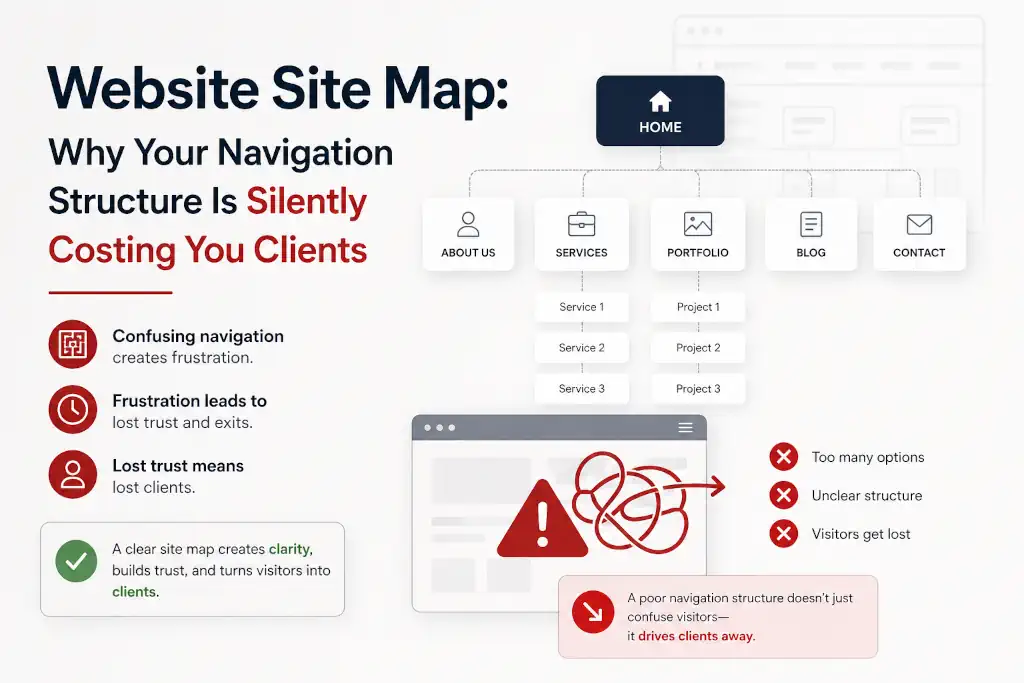
Step 2: The Site Map: The Architecture Your Visitors Navigate Without Knowing It
A beautiful website with poor structure is like a well-designed building with no signs, no logical floor plan, and exits that lead nowhere. People walk in, get confused, and leave.
This is Week 3 of the series on building a website that genuinely brings clients. We have covered the importance of Analysis, understanding your audience, your competition, and your goals before anything is built. Now we move to the next step: Site Map.
Of all the steps in this process, the Site Map is perhaps the most underestimated. Most people think of it as a technical document, something a developer needs, or a file you submit to Google. In reality, a well-constructed Site Map is one of the most strategic decisions in the entire project. It is the moment where the intelligence gathered in the analysis phase becomes an actual structure, a deliberate architecture designed around how your visitors think, move, and decide.
Get it right, and everything that follows, the customer journey, the wireframe, the design, becomes easier, clearer, and more effective. Get it wrong, and no amount of beautiful design will save you.
What a Site Map Actually Is
There is often confusion around the term, so let me be precise.
A sitemap is an outline of all the pages and links on your site, which informs how you structure your navigation. Navigation, by contrast, is the series of menus users actually take to browse through your site and its content. They are related, but they are not the same thing.
A sitemap is a visual representation of the organization of your site's content, a hierarchy of nodes, usually represented as boxes, that signify the pages on your website. Arrows or lines demonstrate the relationship between the web pages.
In practice, a Site Map answers three questions before a single design decision is made:
- What pages does this website need? Not what pages the business wants to show, but what pages the visitor needs to encounter in order to move toward a decision.
- How are those pages related to each other? Which pages are primary, which are secondary, and how does a visitor logically move between them?
- What is the hierarchy? Which pages carry the most strategic weight, and how prominently should they be positioned?
This is the foundation on which everything else is built. When done correctly and with intention, solid information architecture expedites the design and development process immensely. With the structure in place, one built on a thorough understanding of the user, you set the ball in motion to build a complete experience that considers every step of the user journey.
The Mistake That Kills Perfectly Designed Websites
Here is what I see most often in websites that look professional but produce no results: the structure was built around the business, not around the visitor.
The menu reflects the company's internal departments. The pages are organized around what the business wants to say. The hierarchy prioritizes the owner's ego, an "About Us" page front and center, a services page buried two clicks deep, a contact page that requires effort to find.
When menu items are organized by user intent rather than internal logic, engagement increases significantly. Navigation is not just a list of links, it is a silent guide that influences behavior.
That word, silent is important. Visitors do not consciously analyze your navigation. They feel it. When the structure is logical and intuitive, they move through the site with ease and confidence. When it is not, they feel friction, a vague sense of confusion or effort, and they leave. Often without knowing why.
61% of users say they will move on to another website immediately if they cannot find what they are looking for right away. That is not a content problem. That is a structure problem.
The Psychology Behind Good Site Architecture
This is the way people navigate a website is not random, it follows predictable psychological patterns.
Cognitive load is the first principle to understand. The human brain has a limited capacity for processing information at any one moment. A navigation menu with too many items, or a page structure with too many levels, creates cognitive overload. The more items in your navigation, the more difficult the information is to scan and process for visitors. Items at the beginning and end of a navigation list receive the most attention, this is called the serial-position effect, combining the primacy effect and the recency effect. This is not a design opinion. It is a documented characteristic of human memory and attention.
Decision fatigue is the second principle. When visitors are presented with too many choices simultaneously, they tend to make no choice at all. A well-designed Site Map reduces the number of decisions a visitor must make at each step, creating a clear and natural path toward the one action that matters most.
Mental models are the third principle. Every visitor arrives at your website with a pre-existing expectation of how websites in your industry are structured. Deviating too far from that expectation creates disorientation. Understanding and adapting to user behavior is crucial, analytics and heatmaps reveal how users navigate through sites in real-world scenarios, allowing for design changes that align website structure with actual user behavior rather than assumptions.
What a Properly Built Site Map Includes
When I build a Site Map for a project, I work through a specific set of questions that ensure the structure serves the visitor, not the business owner's preferences.
Primary pages: These are the pages that carry the highest strategic value and should be immediately accessible from any point in the site. For most businesses, these are: Home, Services or Products, About, and Contact. The number should be kept tight. 55% of marketing websites have a contact button in the top right, this has become a web design standard because it meets visitor expectations at the exact moment they are ready to act.
Secondary pages: These support the primary pages and provide the depth that builds trust and authority: individual service pages, case studies, a blog or resource section, FAQs. Each of these should have a clear relationship to a primary page and should exist because a visitor needs it, not because the business wants another page on the site.
Conversion pathways: This is the element most often missing from DIY site maps. Every page must have a deliberate next step. Where does the visitor go from the homepage? From the about page? From a service description? By defining your primary conversion points upfront, you can design your website's structure and navigation in a way that supports and guides visitors towards desired outcomes. Without this, visitors arrive, read, and leave, with no prompt, no path, and no reason to take action.
SEO structure: The Site Map is also the moment where search engine strategy is built into the architecture. Your website architecture, not just the navigation, is key for SEO. A well-optimized website has a dedicated page for each service, each product, each key topic, not a single "services" page that bundles everything together. Each page needs its own reason to exist, its own keyword focus, and its own place in the hierarchy.
The DIY Trap, And Why Designers Fall Into It Too
Building a website yourself, you naturally organize it around what you know, your business, your terminology, your priorities. That is understandable. But it produces a website that speaks a language your visitors may not recognize.
I have seen this with professional designers as well. A designer whose strength is visual may build a Site Map quickly, treating it as a formality to get through before the real work begins. Without a grounding in consumer behavior and user psychology, even an experienced designer can produce a structure that looks clean on paper but fails in practice.
While you could decide how to structure the site based on what you think is best, it is far better to let the user dictate the direction. Building information architecture and navigation that is easy to use and leads users where they want to go is the most important outcome of the site mapping process.
The Site Map is not a technical document. It is a strategic one. It is the moment where all the knowledge gathered in the analysis phase is translated into a structure that serves real people making real decisions.
What Comes Next
Once the Site Map is established, you know what pages exist, how they connect, and what role each one plays. The next step, the Customer Journey, goes deeper, mapping the specific path a visitor takes from first arrival to final conversion, and identifying every point where they might hesitate, doubt, or leave.
That is the focus of next week's article.
Before then, take a look at your current website, or the one you are planning. Ask yourself honestly: is this structure built around how your visitor thinks? Or around how your business is organized?
The answer will tell you a great deal about why the site is, or is not working.
Feel free to reach out Contact Form
or
Here you can schedule a call with Pier Alberto.
calendly.com/pierinijp/30min